Friday, 28 June 2013

Audio-Based Games Part 1

The first audio-based games could be said to have started with Touch Me (1974) and Simon (1978). Both these games required the player to memorise the pattern of pitched synthesised notes and repeat the pattern (See video's below).


With the development of consoles paving way for 'video' games, only a small selection of game developers worked to created audio-based games. Japanese games development company WARP released several audio-based games in the mid 90's. These included Real Sound: Kaze no Regret (1997) and Enemy Zero (1997). Kenji Eno realised the potential for audio-based games through receiving letters from blind fans, which prompted him to visit a selection of these fans in person.

Nintendo made an attempt to break into the audio-based games market with the release of Soundvoyager, which exploited the stereo field to provide player feedback and position gameplay objects in the audio space of the player.

In more recent times, the development of audio-based/only games has relied heavily on indie game developers and the growing audio games online community. Forums such as game-accessibility and audiogaming provide developers and players to exchange thoughts and ideas with regards to furthering the creative ideas for audio games. Indie games developers have produced recent audio games which all attempt to deliver a different gaming experience for the player.

Papa Sangre (2010) is an iOs horror game that is played through the analysis of sound placement within the stereo filed and changing the visual dial on the phone screen. With a collection of subtle environmental sounds mixed with more dramatic audio such as growling beasts, the gameplay is highly immersive. The use of headphones contributes to the immersive nature of the game as the blocking of all other sounds enables the player to focus solely on the gameplay.


With a collection of audio based games appearing in mobile phone game markets, little can be said for pc or console games. There are almost no audio based games that take advantage of gestural interfaces such as the MS Kinect, PS Move and Nintendo Wii.

Gestures add an element of physicality to computer games, which can contribute to feeling immersed in gameplay through the feeling of being physically connected to the in-game character or game/audio mechanics. With audio-based games choosing to distance themselves from the video elements of common computer games, gestures could offer the opportunity to expand on the foundations of audio-based games developers. The physical nature of gestures within audio games could add a new element, which will enhance the gameplay for players of audio games, who have currently been bound to only audio and button/screen gameplay control.

More to follow...

Thursday, 13 June 2013

Atari Punk Dreamcast

I received a comment on one of my YouTube videos the other day (Rare occurrence), so I felt inclined to visit the users channel and view their work. To my surprise I found a video entitled - Atari Punk Dreamcast - [Circuit bent w/ opto theremin]. I think its fair to say my mind was blown... 


Saturday, 8 June 2013

Sound Design for Animation

During the last week of university I was contacted by Bratislav Vidanovic, with regards to creating sound design for a short animation. After viewing the clip, it seemed obvious to use a granular approach, whilst ending on a more recognizable sound.


The piano note ending might become a "thing" I do, who knows!

Sound for Image

Since the recent completion of university coursework and the start of my final project, several sound design opportunities have become available. One of which is the collaboration between myself and a North West based photographer. We will be working together to create several works that will combine both images and soundscapes.

The idea stemmed from a recent academic assignment that involved creating two contrasting soundscape moods to a rather dull and static piece of visual media. The task required only sound effects to be used to evoke emotion and suggest a mood. Challenging as it was, the outcome provided myself with experience and the understanding that in scenarios such as these, iconic sounds are often very effective. Below are the two contrasting moods...


Mood Soundscape 1

Mood Soundscape 2


The collection of soundscapes that will be produced in conjunction with the photographer's work will take a slightly different and more abstract approach than the works above. One of the limitations I found with the academic soundscapes was the lack of creative style that was able to be implemented. With little or no limitations in the upcoming soundscapes, an attempt will be made to maintain the use of iconic sounds. However much more emphasis will be taken towards manipulating audio and creating an acousmatic under-layer to the soundscape.

Will post work in progress over the next few weeks

Friday, 19 April 2013

Doppler Effect in Logic

A project I am currently working on requires the sound of an ice cream van to pass by, creating the doppler effect as it does so. One obvious method of achieving this would be to record the sound of a passing ice cream van, however due to the bleak Yorkshire weather we won't be seeing one of them anytime soon.


So I ventured onto Mister Softee to locate the sample the ice cream vans use in the UK and applied some editing techniques to allow the sample to loop seamlessly. The sample itself seems to be a worldized recording so little editing of the sound was needed at this stage.


Method

Once the sample is positioned in Logic, changes need to be made to the output of the track. The default setting is usually Output 1-2, this needs to be changed to Binaural for the technique to work.


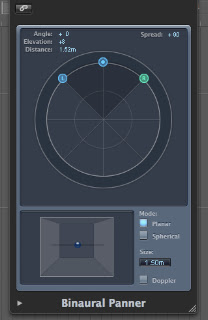
Logic will still display Output 1-2 however, if clicked it will display Binaural selected. The selection of Binaural changes the panning display from the default stereo dial to a dial ideal for automating Binaural audio (See image below).


If this new dial is clicked an enlarged version appears in a pop up window. Several changes need to be made to this window to successfully allow the doppler effect to be made.


Firstly change the size from 1.50m to 20.0m by either double clicking on the box and typing or click on the box and drag the mouse up or down. Next select the box on the left of the word Doppler. The visual representation of the binaural audio field should display three circles and cone shaped shadow connecting them.

There are several ways to approach making the doppler effect apply to the audio files within the track, but I find the most effective method requires a form of automation. Using the  touch function, which tracks the real time movement of the binaural panner, allows for accurate movement of the sound in real time. To create the change in pitch, quick but short movements of the spread is required.


This can be tweaked by opening the automation view in logic (Press A) as displayed by the image below.


Tuesday, 16 April 2013

Disguising the voice

I have recorded an argument between a male and female, however for its application within the mix I require the words to be unclear (avoiding any recognizable reason to be arguing).

Here is a sample of the original sound file: Couple Argument (Sample)
This sample was then processed through plug-ins available in Audacity. Extreme processing could have been applied however, it was important to keep the emotion delivered by both voices.


The first attempt was made through filtering techniques by only allowing the low frequencies to enter the mix. This first sample uses a low pass filter: Couple Argument (Sample) LPF 48dB Roll off 48dB and Cut off 1301.0Hz

This was furthered by the addition of a phaser: Couple Argument (Sample) LPF and Phaser

The final method was to use both a Low Pass Filter and a Vocoder which resulted in the blurring of words: Couple Argument (Sample) LPF and Vocoder

One of the issues with these methods was that the sound source includes both male and female voices, which have different frequencies.

Plenty more methods to try
To be continued!

Saturday, 30 March 2013

Soundtracking in Cinematics

After posting my last video (Gears of War Trailer), I started to think about the implications of adding music to a game cinematic. What positives are taken away from adding music and do they outweigh the cons? As explained in my last post, my personal choice to add a soundtrack to the trailer, seemed to stem from my experience in viewing the original (see below), which could have subconsciously made me believe that this trailer needs music to evoke an emotion, that sound design alone simply can not.


Personally, I think that the original captured the emotion, story line and characterization of Markus Fenix perfectly. The use of the song 'Mad World' could be said to signify the chaotic landscape that the invasion of Locust created. The silencing of sound design is another technique that is used skillfully to possibly portray the isolation of the character in shot (Markus Fenix).

There is another interesting use of music in Gears of War, which would seem more obvious and heart wrenching for gamers who had the joy of battling through all three gears of war campaigns. The clip below is a cinematic from Gears of War 3 and shows the death of the character Dom.


Once you have cleared the tears from your eyes, it is clear that the music is a slightly varied orchestration to 'Mad World'. Firstly, the music brings back the memories of Markus running for his life, all alone in the first Gears of War trailer. Now his best friend is dead.. the loneliness is back.

In this cinematic the sound design is still prominent in the mix, however subtle low pass filtering during the explosions of Dom's death, allow the 'Mad World' music to piece through with the same effect produced by the first Gears of War trailer.


Anyway, just some thoughts!